
Real Estate Trends
Market Insights
5 min read
What is an iBuyer? Why is Everyone Making a Big Fuss Out of It?
Learn what iBuyers are, how they work, and why they've become one of the most talked-about topics in real estate. Discover the pros, cons, and whether selling to an iBuyer makes sense for your situation.
iBuyer
Home Selling
Real Estate Trends
Market Insights
Arizona Real Estate

Lindsay Mozena
Founder · Vista Group Realty

What is an iBuyer?
An iBuyer is an company or group of investors that make an offer on a home without seeing it. They are essentially the exact same thing as a flipper but they have a new name to go with the digital age.
Why did iBuyers become such a big deal?
We live in a fast-paced age of convenience and when Real Estate Agents don’t truly explain the 180 tasks it takes to work with a single client and they don’t show the value- then going to an iBuyer makes sense. It’s easy, quick, and at the seller’s own pace. It can be a good option for people who really need to get out quickly and don’t care how much they will earn on the sale of their home.
So why NOT go with an iBuyer?
There is always a cost of convenience and working with an iBuyer is not different.
They are investors, so the offer you receive will be an “investor offer” which is below market value. Keep in mind their entire strategy is to buy your house, do some minor cosmetic touch ups, and then put it back on the market for a much higher price.
First of all, an iBuyer will charge a “Service Fee” which is a percentage of the sale. This is the exact same thing as a commission percentage that you pay to an agent but they changed the name to make it easier for the seller to swallow since they think it’s just part of the service. We have seen a service fee in the range of 8.5%-13% on every single iBuyer transaction we have helped a client navigate this year.
Then the iBuyer will typically do an inspection where they will tack on an additional 2-5% debit to cover the cost of repairs and this is non-negotiable. There are also usually higher closing costs, a holding fee, and other service fee’s that make their way to the closing table.
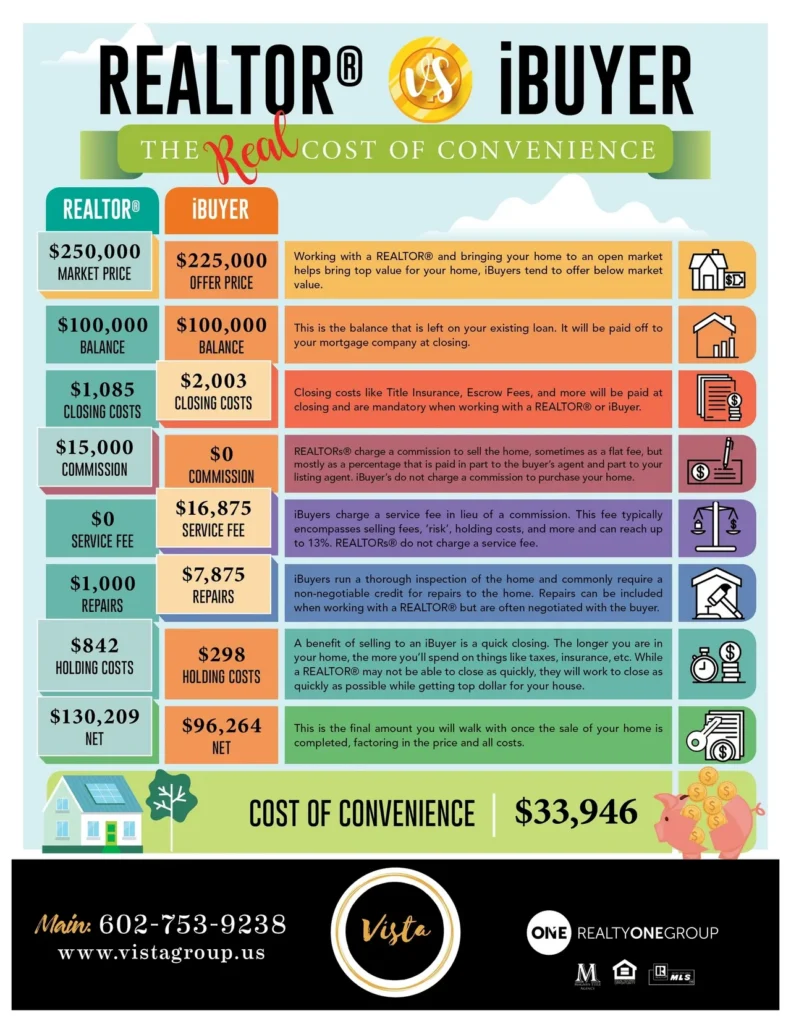
So at the end of the day you will receive an offer that is under the market value for your home and you will be charged 13-15% of that offer price to close. Here is a good breakdown for you.
So what do real estate agents really do anymore?
Experienced Real Estate Agents are your boots on the ground. They live in the market every single day. They don’t sit behind a screen crunching numbers and aren’t focused on the investors bottom line. They are focused on you, the neighborhood, the area, the day to day fluctuations. They know the market because they are in the homes every day, they look at the MLS and then compare it to what they see in person. They know the community and why the value of living next to a freeway wouldn’t be as high for a home compared to one that lives in a quiet cul-de-sac. They know the good, the bad, the ugly. A person sitting behind a computer cannot take away the real estate agent’s human connection and knowledge of the area they live and work in.
Let me reiterate- USE EXPERIENCED agents. Arizona has over 80,000 licensed agents, many hoping to work part time and make a quick buck without putting in any effort to truly know and understand what it takes. An experienced agent who has made real estate their full time career and not a passing hobby- lives, eats, and breathes real estate. They are consumed with economic growth patterns, how new business in the valley affects you, what homes have come onto the market and why some homes aren’t selling. They know and study designs and market trends. They are your researcher, your negotiator, your counselor, your idea generator, your relocation coordinator, your new home finder, your designer, and your partner in the process. They go to battle for you on your behalf to make sure you get the best possible outcome. Furthermore, a good agent make sure it’s the best possible outcome for ALL parties. They answer your calls, texts, and emails at their kids baseball games or on 8pm on a Saturday night when you’re freaking out because you don’t know if you still want to proceed. They are your companion throughout the process to keep you as stress free as possible so that you can achieve your goals. According to the National Association of Realtors, there is 184 steps that an agent will go through to get you to the closing table! (See below) They are worth their weight in gold and cost significantly less. For example if a total commission is 6% for the seller to sell his home it breaks down where a portion goes to the selling agent and a portion goes to the buyers agent. For example: the sellers agent would earn 3% and the buyers agent would earn 3%. Let’s break it down further.
If you list your house with our team, it takes 3 people (listing manager, transaction coordinator, and listing agent) and 10 hours to get the listing active on the market. If we are doing pre-marketing activities the agent usually devotes an additional 15 hours to those activities. We spend money for professional photos, marketing, and signage which can include custom signs for the property. We invest over $1,500 on your home before we even get it on the market and that doesn’t take into account the agent’s time.
On average a listing takes 15 hours a week until it closes. This includes checking the market for new updates, communicating with sellers and buyers on the home, prospecting for buyers, home tours, open houses, etc. Let’s say from beginning to end the listing takes 60 days. That means for 8 weeks and 130 hours the agent has worked for YOU the seller. Additionally, the selling agent often spends money during the process for a transaction coordinator and other business related items to get you to the closing table (gas, staging, cleaning, print materials, brokerage fee’s, etc). All the while you have spent $0 out of pocket until the home closes.
Let’s use the example above for the home sale. If you sell your home for $250,000 and the commission the listing agent earns is $7,500. Less the cost of the sale (which is not charged to the seller) $2,700 leaves a net of $4,800. Then the agent still needs to pay taxes. The agent will earn $37 an hour on that sale so that YOU can net $130,209 or $33,946 more than you would earn when working with an iBuyer. You have literally earned $261 MORE per hour for every hour that agent has worked for you! I’d say that is money well spent for an expert, wouldn’t you?
Curious about those 184 tasks? Here is the full list below.
REALTORS® perform a myriad of tasks to ensure that the home buying process goes smoothly for their clients. This list was originally prepared by the Orlando Area Association of REALTORS®. The National Association of REALTORS® (NAR) presented it to Congress to demonstrate all the tasks that real estate professionals must do to close a single transaction.
Pre-listing activities
___ 1. Make appointment with seller for listing presentation.
___ 2. Send a written or e-mail confirmation of appointment and call to confirm.
___ 3. Review appointment questions.
___ 4. Research all comparable currently listed properties.
___ 5. Research sales activity for past 18 months from MLS and public databases.
___ 6. Research “average days on market” for properties similar in type, price and location.
___ 7. Download and review property tax roll information.
___ 8. Prepare “comparable market analysis” (CMA) to establish market value.
___ 9. Obtain copy of subdivision plat/complex layout.
___ 10. Research property’s ownership and deed type.
___ 11. Research property’s public record information for lot size and dimensions.
___ 12. Verify legal description.
___ 13. Research property’s land use coding and deed restrictions.
___ 14. Research property’s current use and zoning.
___ 15. Verify legal names of owner(s) in county’s public property records.
___ 16. Prepare listing presentation package with above materials.
___ 17. Perform exterior “curb appeal assessment” of subject property.
___ 18. Compile and assemble formal file on property.
___ 19. Confirm current public schools and explain their impact on market value.
___ 20. Review listing appointment checklist to ensure completion of all steps.
Listing appointment presentation
___ 21. Give seller an overview of current market conditions and projections.
___ 22. Review agent and company credentials and accomplishments.
___ 23. Present company’s profile and position or “niche” in the marketplace.
___ 24. Present CMA results, including comparables, solds, current listings and expireds.
___ 25. Offer pricing strategy based on professional judgment and interpretation of current market conditions.
___ 26. Discuss goals to market effectively.
___ 27. Explain market power and benefits of multiple listing service.
___ 28. Explain market power of Web marketing, IDX and REALTOR.com.
___ 29. Explain the work the brokerage and agent do “behind the scenes” and agent’s availability on weekends.
___ 30. Explain agent’s role in screening qualified buyers to protect against curiosity seekers.
___ 31. Present and discuss strategic master marketing plan.
___ 32. Explain different agency relationships and determine seller’s preference.
___ 33. Review all clauses in listing contract and obtain seller’s signature.
After listing agreement is signed
___ 34. Review current title information.
___ 35. Measure overall and heated square footage.
___ 36. Measure interior room sizes.
___ 37. Confirm lot size via owner’s copy of certified survey, if available.
___ 38. Note any and all unrecorded property lines, agreements, easements.
___ 39. Obtain house plans, if applicable and available.
___ 40. Review house plans, make copy.
___ 41. Order plat map for retention in property’s listing file.
___ 42. Prepare showing instructions for buyers’ agents and agree on showing time window with seller.
___ 43. Obtain current mortgage loan(s) information: companies and account numbers.
___ 44. Verify current loan information with lender(s).
___ 45. Check assumability of loan(s) and any special requirements.
___ 46. Discuss possible buyer financing alternatives and options with seller.
___ 47. Review current appraisal if available.
___ 48. Identify Home Owner Association manager if applicable.
___ 49. Verify Home Owner Association fees with manager — mandatory or optional and current annual fee.
___ 50. Order copy of Homeowner Association bylaws, if applicable.
___ 51. Research electricity availability and supplier’s name and phone number.
___ 52. Calculate average utility usage from last 12 months of bills.
___ 53. Research and verify city sewer/septic tank system.
___ 54. Calculate average water system fees or rates from last 12 months of bills.
___ 55. Or confirm well status, depth and output from Well Report.
___ 56. Research/verify natural gas availability, supplier’s name & phone number.
___ 57. Verify security system, term of service and whether owned or leased.
___ 58. Verify if seller has transferable Termite Bond.
___ 59. Ascertain need for lead-based paint disclosure.
___ 60. Prepare detailed list of property amenities and assess market impact.
___ 61. Prepare detailed list of property’s “Inclusions & Conveyances with Sale .”
___ 62. Compile list of completed repairs and maintenance items.
___ 63. Send “Vacancy Checklist” to seller if property is vacant.
___ 64. Explain benefits of Home Owner Warranty to seller.
___ 65. Assist sellers with completion and submission of Home Owner Warranty application.
___ 66. When received, place Home Owner Warranty in property file for conveyance at time of sale.
___ 67. Have extra key made for lockbox.
___ 68. Verify if property has rental units involved. And if so:
___ 69. Make copies of all leases for retention in listing file.
___ 70. Verify all rents and deposits.
___ 71. Inform tenants of listing and discuss how showings will be handled.
___ 72. Arrange for yard sign installation.
___ 73. Assist seller with completion of Seller’s Disclosure form.
___ 74. Complete “new listing checklist.”
___ 75. Review results of Curb Appeal Assessment with seller and provide suggestions to improve salability.
___ 76. Review results of Interior Décor Assessment and suggest changes to shorten time on market.
___ 77. Load listing into transaction management software program.
Entering property in MLS database
___ 78. Prepare MLS Profile Sheet — agent is responsible for “quality control” and accuracy of listing data.
___ 79. Enter property data from Profile Sheet into MLS listing database.
___ 80. Proofread MLS database listing for accuracy, including proper placement in mapping function.
___ 81. Add property to company’s Active Listings list.
___ 82. Provide seller with signed copies of Listing Agreement and MLS Profile Sheet Data Form within 48 hours.
___ 83. Take additional photos for upload into MLS and use in flyers. Discuss efficacy of panoramic photography.
Marketing the listing
___ 84. Create print and Internet ads with seller’s input.
___ 85. Coordinate showings with owners, tenants, and other Realtors®. Return all calls — weekends included.
___ 86. Install electronic lock box if authorized by owner. Program with agreed-upon showing time windows.
___ 87. Prepare mailing and contact list.
___ 88. Generate mail-merge letters to contact list.
___ 89. Order “Just Listed” labels and reports.
___ 90. Prepare flyers and feedback faxes.
___ 91. Review comparable MLS listings regularly to ensure property remains competitive in price, terms, conditions and availability.
___ 92. Prepare property marketing brochure for seller’s review.
___ 93. Arrange for printing or copying of supply of marketing brochures or flyers.
___ 94. Place marketing brochures in all company agent mailboxes.
___ 95. Upload listing to company and agent Internet sites, if applicable.
___ 96. Mail “Just Listed” notice to all neighborhood residents.
___ 97. Advise Network Referral Program of listing.
___ 98. Provide marketing data to buyers from international relocation networks.
___ 99. Provide marketing data to buyers coming from referral network.
___ 100. Provide “Special Feature” cards for marketing, if applicable.
___ 101. Submit ads to company’s participating Internet real estate sites.
___ 102. Convey price changes promptly to all Internet groups.
___ 103. Reprint/supply brochures promptly as needed.
___ 104. Review and update loan information in MLS as required.
___ 105. Send feedback e-mails/faxes to buyers’ agents after showings.
___ 106. Review weekly Market Study.
___ 107. Discuss feedback from showing agents with seller to determine if changes will accelerate the sale.
___ 108. Place regular weekly update calls to seller to discuss marketing & pricing.
___ 109. Promptly enter price changes in MLS listings database.
The offer and contract
___ 110. Receive and review all Offer to Purchase contracts submitted by buyers or buyers’ agents.
___ 111. Evaluate offer(s) and prepare “net sheet” on each for owner to compare.
___ 112. Counsel seller on offers. Explain merits and weakness of each component of each offer.
___ 113. Contact buyers’ agents to review buyer’s qualifications and discuss offer.
___ 114. Fax/deliver Seller’s Disclosure to buyer’s agent or buyer upon request and prior to offer if possible.
___ 115. Confirm buyer is pre-qualified by calling loan officer.
___ 116. Obtain pre-qualification letter on buyer from loan officer.
___ 117. Negotiate all offers on seller’s behalf, setting time limit for loan approval and closing date.
___ 118. Prepare and convey any counteroffers, acceptance or amendments to buyer’s agent.
___ 119. Send copies of contract and all addendums to closing attorney or title company.
___ 120. When Offer-to-Purchase contract is accepted and signed by seller, deliver to buyer’s agent.
___ 121. Record and promptly deposit buyer’s earnest money into escrow account.
___ 122. Disseminate “Under-Contract Showing Restrictions” as seller requests.
___ 123. Deliver copies of fully signed Offer to Purchase contract to seller.
___ 124.Deliver copies of Offer to Purchase contract to selling agent.
___ 125. Send copies of Offer to Purchase contract to lender.
___ 126. Provide copies of signed Offer to Purchase contract for office file.
___ 127. Advise seller in handling additional offers to purchase submitted between contract and closing.
___ 128. Change MLS status to “Sale Pending.”
___ 129. Update transaction management program to show “Sale Pending.”
___ 130. Review buyer’s credit report results — Advise seller of worst and best case scenarios.
___ 131. Provide credit report information to seller if property to be seller-financed.
___ 132. Assist buyer with obtaining financing and follow up as necessary.
___ 133. Coordinate with lender on discount points being locked in with dates.
___ 134. Deliver unrecorded property information to buyer.
___ 135. Order septic system inspection, if applicable.
___ 136. Receive and review septic system report and assess any impact on sale.
___ 137. Deliver copy of septic system inspection report to lender and buyer.
___ 138. Deliver well flow test report copies to lender, buyer and listing file.
___ 139. Verify termite inspection ordered.
___ 140. Verify mold inspection ordered, if required.
Tracking the loan process
___ 141. Confirm return of verifications of deposit and buyer’s employment.
___ 142. Follow loan processing through to the underwriter.
___ 143. Add lender and other vendors to transaction management program so agents, buyer and seller can track progress of sale.
___ 144. Contact lender weekly to ensure processing is on track.
___ 145. Relay final approval of buyer’s loan application to seller.
Home inspection
___ 146. Coordinate buyer’s professional home inspection with seller.
___ 147. Review home inspector’s report.
___ 148. Enter completion into transaction management tracking software program.
___ 149. Explain seller’s responsibilities with respect to loan limits and interpret any clauses in the contract.
___ 150. Ensure seller’s compliance with home inspection clause requirements.
___ 151. Recommend/assist seller with identifying and negotiating with trustworthy contractors for required repairs.
___ 152. Negotiate payment and oversee completion of all required repairs on seller’s behalf, if needed.
The appraisal
___ 153. Schedule appraisal.
___ 154. Provide comparable sales used in market pricing to appraiser.
___ 155. Follow up on appraisal.
___ 156. Enter completion into transaction management program.
___ 157. Assist seller in questioning appraisal report if it seems too low.
Closing preparations and duties
___ 158. Make sure contract is signed by all parties.
___ 159. Coordinate closing process with buyer’s agent and lender.
___ 160. Update closing forms and files.
___ 161. Ensure all parties have all forms and information needed to close the sale.
___ 162. Select location for closing.
___ 163. Confirm closing date and time and notify all parties.
___ 164. Assist in solving any title problems (boundary disputes, easements, etc.) or in obtaining death certificates.
___ 165. Work with buyer’s agent in scheduling and conducting buyer’s final walk-through prior to closing.
___ 166. Research all tax, HOA, utility and other applicable prorations.
___ 167. Request final closing figures from closing agent (attorney or title company).
___ 168. Receive and carefully review closing figures to ensure accuracy.
___ 169. Forward verified closing figures to buyer’s agent.
___ 170. Request copy of closing documents from closing agent.
___ 171. Confirm buyer and buyer’s agent received title insurance commitment.
___ 172. Provide “Home Owners Warranty” for availability at closing.
___ 173. Review all closing documents carefully for errors.
___ 174. Forward closing documents to absentee seller as requested.
___ 175. Review documents with closing agent (attorney).
___ 176. Provide earnest money deposit from escrow account to closing agent.
___ 177. Coordinate closing with seller’s next purchase, resolving timing issues.
___ 178. Have a “no surprises” closing so that seller receives a net proceeds check at closing.
___ 179. Refer sellers to one of the best agents at their destination, if applicable.
___ 180. Change MLS status to Sold. Enter sale date, price, selling broker and agent’s ID numbers, etc.
___ 181. Close out listing in transaction management program.
Follow up after closing
___ 182. Answer questions about filing claims with Home Owner Warranty company if requested.
___ 183. Attempt to clarify and resolve any repair conflicts if buyer is dissatisfied.
___ 184. Respond to any follow-up calls and provide any additional information required from office files
Continue Reading
More from Lindsay's Blog